

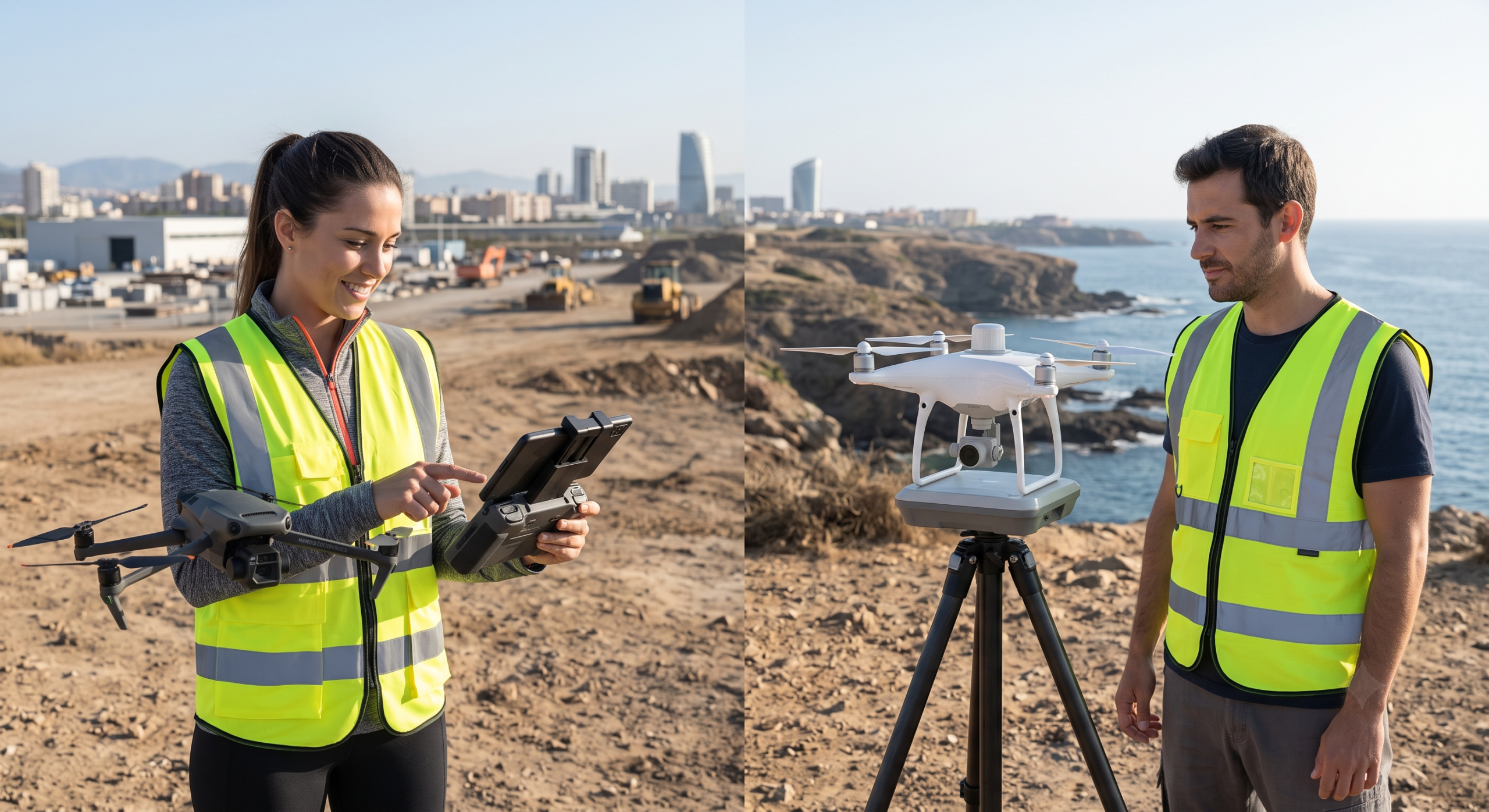
Before getting into specs, there’s a fact that changes this entire comparison: as of 2026, DJI’s own store lists the Phantom 4 RTK as unavailable in most regions, and independent reporting confirms the Phantom 4 line has been wound down in favor of DJI’s Mavic and Matrice platforms. If you’re comparing these two drones as a new-purchase decision, you’re not really choosing between two current products — you’re choosing between an active platform and a discontinued one.
That doesn’t make this comparison useless. A meaningful secondary and used market for the Phantom 4 RTK still exists, some survey teams are still running it in production workflows, and understanding why DJI retired it tells you exactly what to look for in its replacement. Here’s the honest version of this comparison.
The Quick Answer
- Buying new in 2026? Get the Mavic 3 Enterprise (or its 2026 successor, the Mavic 4E) — it’s the current, supported, actively sold platform, and DJI’s own product roadmap has moved survey-grade mapping there and onto the Matrice line.
- Already own a Phantom 4 RTK and it works for your workflow? Keep using it, but budget for the reality that parts, batteries, and official support are shrinking, and plan your migration timeline rather than waiting for a failure to force the decision.
- Buying used specifically for a Phantom 4 RTK-based workflow? Understand you’re buying a legacy platform with a shrinking parts ecosystem — reasonable for a specific, budget-constrained use case, but not a decision to make without eyes open.
What the Phantom 4 RTK Actually Was
Released in 2018, the Phantom 4 RTK paired a 1-inch 20-megapixel sensor with a mechanical shutter — a meaningful detail for photogrammetry, since a mechanical shutter avoids the rolling-shutter distortion that can degrade geometric accuracy during forward flight — with an integrated RTK module delivering roughly 1 cm + 1 ppm horizontal and 1.5 cm + 1 ppm vertical positioning accuracy, aided by DJI’s TimeSync system for precise position-camera synchronization. For years, it was the default recommendation for teams wanting a single, self-contained, ready-to-fly mapping drone without assembling a payload themselves.
It defined an entire generation of survey and construction-mapping workflows, which is exactly why it still shows up in comparison searches years after DJI stopped actively selling it.
What the Mavic 3 Enterprise Offers Instead
The Mavic 3 Enterprise brought the same core idea — RTK-enabled mapping in a self-contained, ready-to-fly package — into DJI’s folding-airframe design language: a larger 4/3-inch sensor, roughly 45-minute flight time, and the portability that a fixed-arm platform like the Phantom 4 simply couldn’t match. Folding arms mean it travels in a much smaller case, deploys faster on site, and survives ground transport better — a genuinely significant operational advantage for teams running multiple sites per week rather than a single fixed installation.
Side-by-Side: What Actually Changed
| Phantom 4 RTK (2018, discontinued) | Mavic 3 Enterprise (current) | |
|---|---|---|
| Airframe | Fixed-arm quadcopter | Folding quadcopter |
| Sensor | 1-inch, 20MP, mechanical shutter | 4/3-inch sensor |
| RTK accuracy | ~1 cm + 1 ppm horizontal, 1.5 cm + 1 ppm vertical | Comparable centimeter-level RTK accuracy |
| Portability | Rigid case, larger footprint | Folds down significantly smaller |
| Availability | Discontinued; DJI store shows unavailable in most regions | Actively sold and supported |
| Parts/support | Shrinking secondary-market supply | Full manufacturer support |
| Successor path | Wound down in favor of Mavic/Matrice lines | Current generation; Mavic 4E is its direct successor |
The mechanical shutter is the one genuine technical edge the Phantom 4 RTK held over many later designs, and it’s worth understanding rather than dismissing: for photogrammetry specifically, a mechanical shutter avoids a category of geometric distortion that global/rolling electronic shutters can introduce during motion. If you’re evaluating a used Phantom 4 RTK against a modern alternative purely on this axis, confirm what shutter type your replacement candidate uses before assuming newer automatically means better for pure mapping accuracy.
Why DJI Retired the Phantom Line
This wasn’t a random discontinuation — it reflects where DJI moved its actual engineering investment. Consumer demand shifted decisively toward foldable airframes for portability, and DJI consolidated its enterprise mapping and survey effort into two lines instead of three: the Mavic Enterprise series for portable, single-operator mapping work, and the Matrice series (350 RTK, and the newer 400 flagship) with swappable Zenmuse payloads for teams needing to choose between photogrammetry and LiDAR sensors on the same airframe. The Phantom’s fixed niche — a single-sensor, non-swappable, rigid-body mapping drone — simply didn’t have a place in that consolidated lineup anymore.
If You’re Still Running a Phantom 4 RTK
You’re not wrong to keep using working hardware. The practical guidance:
- Stock spare batteries and props now, while a secondary market still exists — DJI’s own service and parts support for the broader Phantom line has been shrinking on a published schedule, and availability will only get tighter.
- Don’t buy a used unit as a long-term platform decision without pricing in the eventual migration cost — treat it as a bridge, not a destination.
- Validate your accuracy requirements against a modern alternative before you have to migrate under time pressure. A forced last-minute switch after a hardware failure is a worse position than a planned migration on your own schedule.
What to Actually Buy in 2026
- Portable, single-operator mapping work, similar project profile to what the Phantom 4 RTK covered → Mavic 3 Enterprise or its successor, the Mavic 4E — this is the direct spiritual replacement DJI intends this comparison to resolve to.
- Larger-scale or mixed photogrammetry/LiDAR project loads → The Matrice 350 RTK or the newer Matrice 400, paired with the Zenmuse P1 (photogrammetry) or Zenmuse L3 (LiDAR) payload — this is where DJI actually moved the high-end survey and mapping use case the Phantom 4 RTK used to serve.
- Budget-constrained, small-site work, and you already understand the parts-availability tradeoff → A used Phantom 4 RTK remains a technically capable option, but budget the migration into your near-term plan rather than treating it as indefinite.
Final Verdict
This comparison, as originally framed, answers a question the market has already answered for you: DJI stopped actively selling the Phantom 4 RTK, and its own guidance points buyers toward the Mavic Enterprise and Matrice lines instead. If you’re making a new-purchase decision in 2026, get the Mavic 3 Enterprise (or the newer Mavic 4E) for portable single-operator mapping, or step up to the Matrice 400 with Zenmuse payloads if your project mix needs LiDAR or larger-scale coverage. If you already have a working Phantom 4 RTK, keep flying it — just don’t mistake «still working» for «still a safe long-term bet,» and start planning your migration before a battery or part shortage forces the decision for you.
Not sure whether your specific project profile fits the Mavic Enterprise line or justifies stepping up to a Matrice + Zenmuse setup? Get in touch and we’ll help you map it against your actual site mix.